Here’s one of the stranger things the tax code allows. Your cabin in Pigeon Forge can book solid all summer, put real money in your account, gain value year after year, and still show a loss on your tax return.
That’s depreciation. It’s the single biggest reason real estate has built so much long-term wealth for ordinary investors, and it’s the reason seasoned owners talk about taxes almost as much as they talk about occupancy rates.
Whether you’re buying your first Smoky Mountain rental or your fifth, it pays to understand exactly how it works, and where it can bite you later.
What is depreciation on a rental property?
Quick answer: Depreciation is an annual tax deduction that lets you recover the cost of a rental building over time: generally 27.5 years for long-term residential rentals, and often 39 years for short-term rentals. Land isn’t depreciable. It’s a non-cash deduction, so you claim it without spending any money that year.
The idea is that buildings wear out. Roofs age, decks weather, carpets get tired. The IRS lets you deduct a slice of the building’s cost every year to account for that, whether or not the property actually loses value.
How does depreciation work on a rental property? A Pigeon Forge example
Say you buy a cabin for $550,000. The Sevier County assessment puts 20% of the value in the land, so:
- Land: $110,000 (not depreciable)
- Building: $440,000 (depreciable)
Your annual deduction depends on the recovery period your CPA uses:
| Recovery period | Annual depreciation |
|---|---|
| 27.5 years | about $16,000 |
| 39 years | about $11,280 |
Now say the cabin earns $20,000 after cleaning, utilities, management, insurance, property taxes, and mortgage interest. With $11,280 of depreciation, your taxable income from the property drops to about $8,720. You kept the full $20,000 in cash. You’re taxed on less than half of it.
How depreciation works on a $550,000 cabin in Pigeon Forge: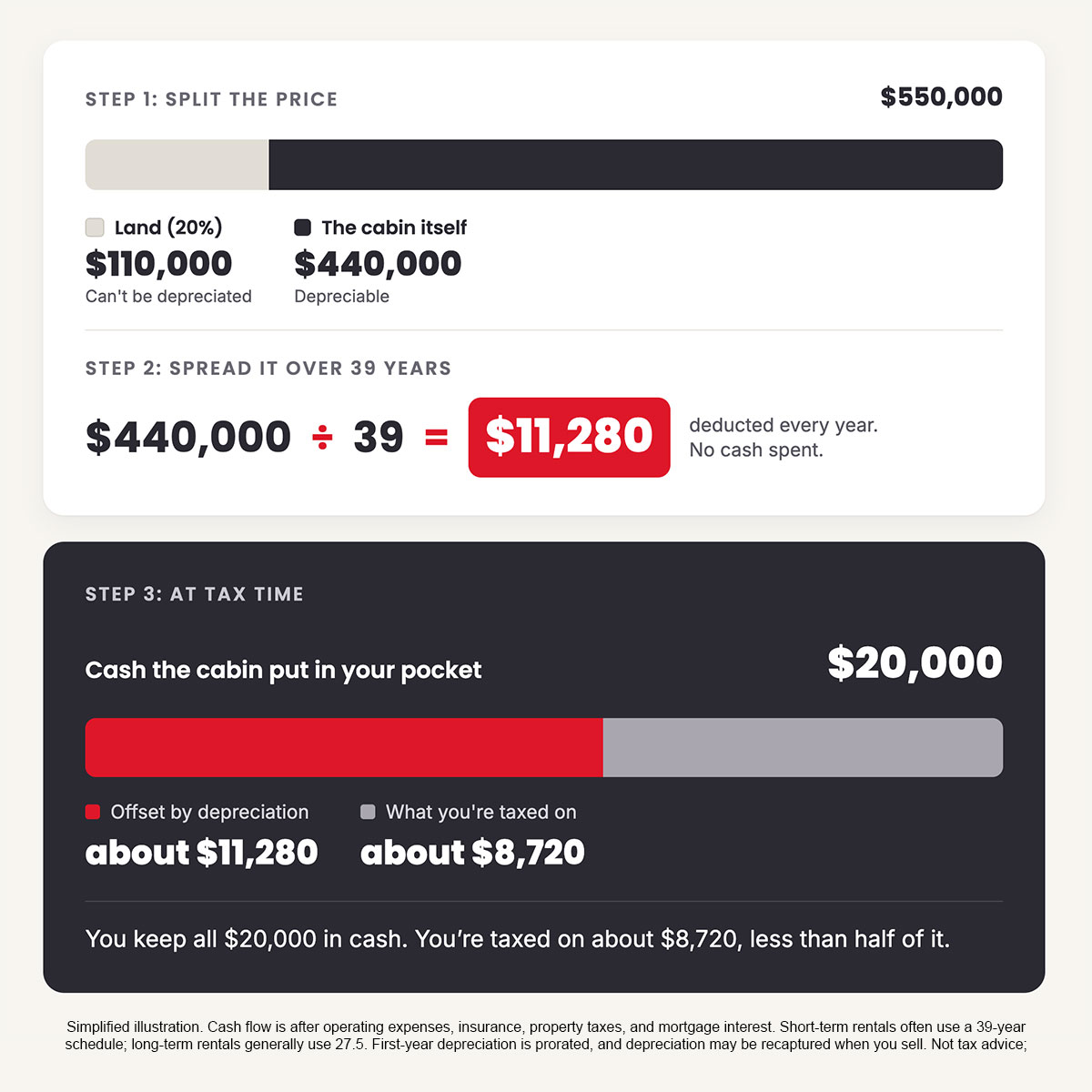
27.5 or 39 years for a short-term rental?
If your cabin’s average guest stay is 30 days or less, many CPAs treat it as closer to a hotel than a home, which means 39 years instead of 27.5. That sounds like bad news, and it does shrink the yearly number. But it’s also part of why short-term rentals can qualify for special tax treatment that long-term rentals can’t. Your CPA makes this call, so ask before you buy. We cover that conversation in 12 Questions to Ask Your CPA Before You Buy an Investment Property in the Smokies.
Why depreciation is an investor’s best friend
1. It’s a deduction for money you didn’t spend this year
Most deductions cost you something. You spend $1,000 on a repair to save a few hundred in taxes. Depreciation is different. You get the deduction every year for the building you already bought, and the cash stays in your account.
2. Your property can go up in value while it goes down on paper
Smoky Mountain cabins don’t usually fall apart in 39 years if they’re cared for. Many appreciate. Meanwhile, the tax code is treating the building as if it’s wearing out. That gap between paper and reality is where a lot of real estate wealth comes from.
3. You depreciate the whole building, not just your down payment
This is the part newer investors often miss. If you put 20% or 25% down and finance the rest with a DSCR loan, you still depreciate the full value of the building, including the part the bank paid for. Leverage multiplies your deduction along with your return.
4. It can offset more than just rental income
Normally, rental losses are passive. They can offset other passive income, and any extra carries forward to future years. It’s not lost, just delayed.
Short-term rentals can be different. If your average guest stay is seven days or less and you materially participate in running the property, those losses may be able to offset W-2 or business income. This is the so-called short-term rental tax loophole, and it’s why so many high earners have bought cabins in Gatlinburg, Pigeon Forge, and Sevierville.
Bonus depreciation in 2026: the accelerator
The building itself is depreciated slowly. But a furnished cabin is more than a building. It’s full of things with much shorter lives: beds, sofas, TVs, appliances, the hot tub, the pool table in the game room, outdoor lighting, paving, landscaping.
Those items can be depreciated over 5, 7, or 15 years, and they can qualify for bonus depreciation, which lets you deduct them all in the first year. Under the One Big Beautiful Bill Act signed in July 2025, 100% bonus depreciation is now permanent for qualifying property acquired after January 19, 2025. Before that law, it had been phasing down and was on track to hit zero.
The tool that identifies those components and puts a dollar figure on each is a cost segregation study. It’s how investors turn depreciation from a nice yearly deduction into a large first-year one.
A few things experienced investors still get wrong
Skipping depreciation doesn’t save it for later. The IRS reduces your basis by the depreciation you were allowed to take, whether or not you took it. Skip it, and you can still face recapture on depreciation you never got the benefit of. If you missed it in past years, a CPA can usually catch it up with an accounting method change instead of amending old returns.
Personal use changes the math. Spending a couple of weekends at your own cabin is part of the fun. But if your personal use runs past 14 days or 10% of the days it’s rented, whichever is greater, your deductions, depreciation included, can be limited. Track your own stays like you track guest bookings.
Improvements have their own clocks. A new roof, a replacement hot tub, or a deck rebuild each gets its own depreciation schedule. And when you replace something, your CPA may be able to write off the remaining value of the old one.
Your home state may not follow federal rules. Tennessee doesn’t tax wages, but plenty of Smokies investors live in states that don’t conform to federal bonus depreciation. Your state return could look different from your federal one.
The catch: depreciation recapture
Depreciation isn’t free money forever. When you sell, the IRS generally taxes back the depreciation you took. For the building itself, that recapture is capped at a 25% federal rate. Faster-depreciated items like furniture and equipment can be taxed at ordinary income rates.
There are well-worn ways to manage that:
- 1031 exchange: sell and roll the proceeds into another investment property to defer the tax.
- Hold long term: under current law, heirs who inherit property generally receive a stepped-up basis, which can wipe out the deferred tax. That’s one reason rental property is such a common tool for building generational wealth.
- Time it with your income: selling in a lower-income year can soften the hit.
Even with recapture, getting a deduction today and paying later, often much later and sometimes never, is usually a good trade. Money saved now can go toward reserves, upgrades, or your next down payment.
Why depreciation won’t hurt your DSCR loan
There’s one more angle that matters if you want to own more than one property. The more depreciation you claim, the lower your taxable income looks. That’s great at tax time, but it can hurt you with a conventional lender, who qualifies you based on what your tax return shows.
A DSCR loan looks at the property instead: does its rental income cover the monthly payment? That means you can take every deduction your CPA recommends without shrinking your buying power for the next cabin.
The DSCR math is simple. A lender divides the property’s expected monthly rental income by its monthly payment (principal, interest, taxes, insurance, and any HOA dues). A cabin projected to bring in $4,500 a month with a $3,750 payment has a debt service coverage ratio of 1.2, meaning the rent covers the payment with 20% to spare. Your depreciation schedule never enters the calculation. Try it on a cabin you’re considering with our free DSCR calculator.
First Choice Lending Services finances short-term rentals throughout Sevier County and East Tennessee. If you’re thinking about your first cabin or adding to your portfolio, talk with our team about DSCR loans for Smoky Mountain short-term rentals.
Want a second set of eyes on a specific cabin? We’ll put together a free rental history and investment analysis for any property you’re considering, and we can connect you with CPAs who work with Smokies short-term rental owners every day.
Frequently asked questions
Can I depreciate the land my cabin sits on? No. Only the building and its components are depreciable. That’s why the land-to-building split at purchase matters so much.
Can I depreciate furniture in my Airbnb? Yes. Furniture, appliances, and similar items are typically 5- or 7-year property, and they can qualify for 100% bonus depreciation, which allows the full cost to be deducted in the first year.
Is depreciation optional on a rental property? Not really. The IRS treats your basis as reduced by the depreciation you were allowed to take, even if you didn’t claim it, so skipping it usually costs you at sale.
What is depreciation recapture? When you sell a rental, the IRS taxes back the depreciation you claimed. Recapture on the building is capped at 25% federally. It can be deferred with a 1031 exchange.
Is bonus depreciation still 100% in 2026? Yes. The One Big Beautiful Bill Act made 100% bonus depreciation permanent for qualifying property acquired after January 19, 2025.
How is a DSCR ratio calculated? Divide the property’s expected monthly rental income by its monthly payment, including principal, interest, taxes, insurance, and HOA dues. A result of 1.0 means the rent exactly covers the payment; anything above 1.0 means it covers it with room to spare. Check out our free DSCR calculator.
This article is for educational purposes only and is not tax, legal, or financial advice. Tax rules change and depend on your situation, so talk with a qualified CPA or tax professional before making decisions. First Choice Lending Services, NMLS #473797. Licensed in TN, KY, GA, and FL. Equal Housing Lender. All loans subject to credit approval and underwriting guidelines.