
The 3 Economic Indicators We Watch Every Week (and Why They Matter to Mortgage Rates)
If you’ve been following mortgage rates lately, you’ve probably noticed they seem to change for reasons that aren’t always obvious. One week rates improve, the next they climb — even though the Federal Reserve hasn’t announced any major changes.
So what’s really driving mortgage rates?
While no one can predict where rates will go with complete certainty, there are three key indicators that mortgage professionals watch every week because they have a significant influence on the direction of interest rates.
Understanding these indicators can help you make more informed decisions when buying a home or refinancing — and help separate the headlines that matter from the ones that don’t.
To put these three indicators in perspective, we pulled ten years of data comparing each one against the 30-year fixed mortgage rate. Here’s what the numbers actually show.
1. The 10-Year Treasury Yield: The Best Day-to-Day Indicator
If there is one number that gives us the clearest picture of where mortgage rates may be headed, it’s the yield on the 10-Year U.S. Treasury Note.
Mortgage rates aren’t tied directly to the Federal Funds Rate. Instead, they tend to move in the same general direction as the 10-Year Treasury because both compete for investor dollars. When investors demand higher returns on Treasury bonds, mortgage-backed securities typically need to offer higher yields as well. That generally translates into higher mortgage rates.
Likewise, when Treasury yields fall, mortgage rates often improve.
The relationship isn’t exact, but it’s one of the strongest indicators professionals monitor every day. Here’s a chart showing how closely the 10-year has tracked mortgage rates over the past decade — notice how the two lines move almost in lockstep, year after year:
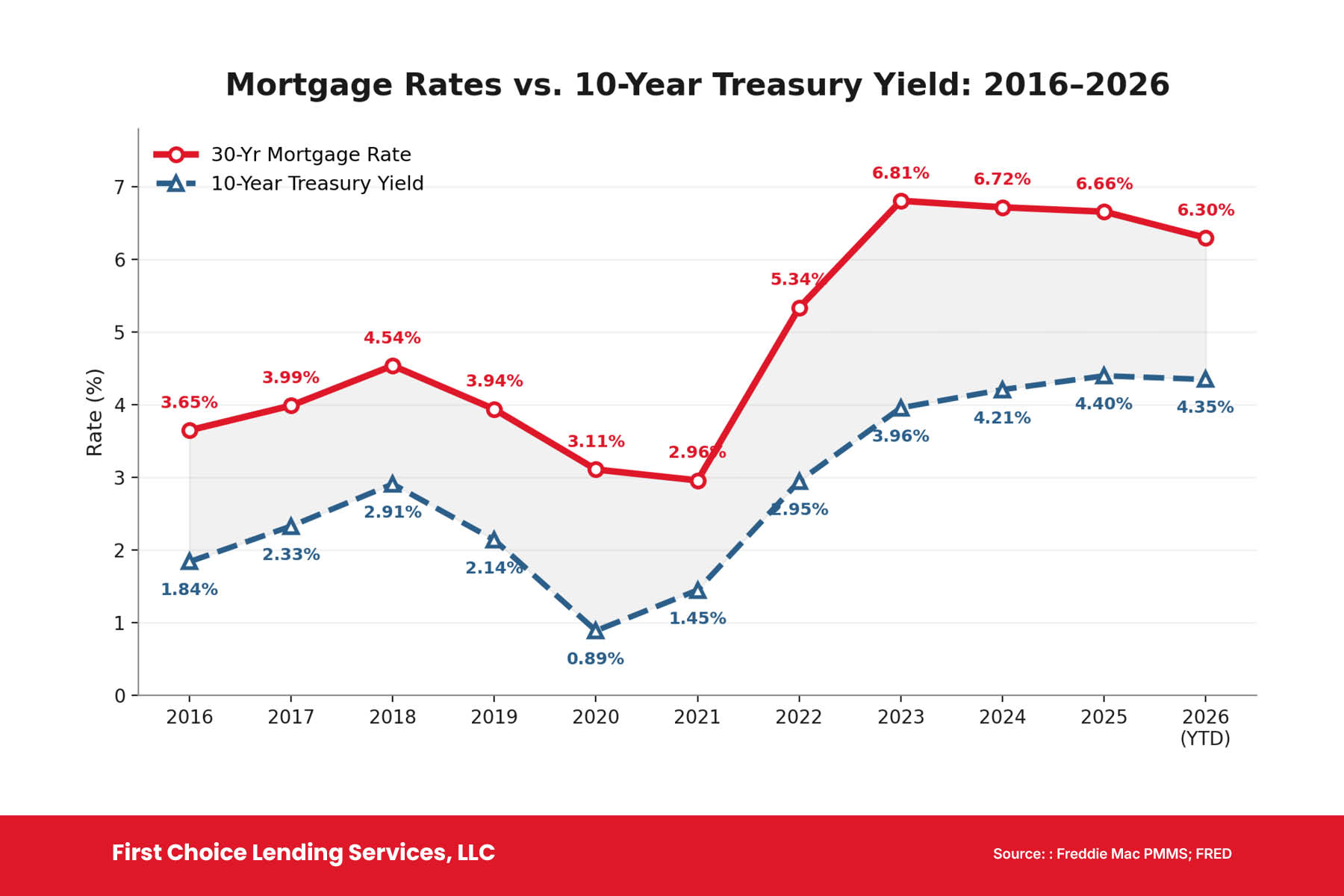
30-Year Mortgage Rate vs. 10-Year Treasury Yield, 2016–2026 (Source: Freddie Mac PMMS; FRED)
You’ll also notice the gap between the two lines — mortgage rates typically run 1.5 to 2 points above the Treasury yield. That spread widened to nearly 3 points in 2023, reflecting extra risk premium lenders were pricing in during a volatile market. When that spread is unusually wide, it’s often a sign mortgage rates have room to improve even without the Treasury yield moving at all.
Why it matters to homebuyers: When you hear that the 10-Year Treasury yield is rising or falling, there’s a good chance mortgage rates may follow a similar path.
2. Inflation: The Biggest Long-Term Driver
Inflation remains one of the most important factors affecting mortgage rates.
Inflation measures how quickly the prices of everyday goods and services are increasing. When inflation stays elevated, investors become concerned that the purchasing power of future dollars will decline. To offset that risk, they demand higher returns on bonds, including mortgage-backed securities.
Higher bond yields typically lead to higher mortgage rates.
This is why mortgage rates don’t always fall simply because the Federal Reserve pauses or even lowers short-term interest rates. Investors are looking beyond this weeks Fed meeting and asking a bigger question:
“Will inflation remain under control over the next several years?”
The chart below shows just how tightly the two have moved together over the last ten years. Inflation spiked to 8% in 2022, and mortgage rates followed with a lag — climbing from the high-2% range in 2021 to nearly 7% by 2023, even as inflation itself had already started cooling:
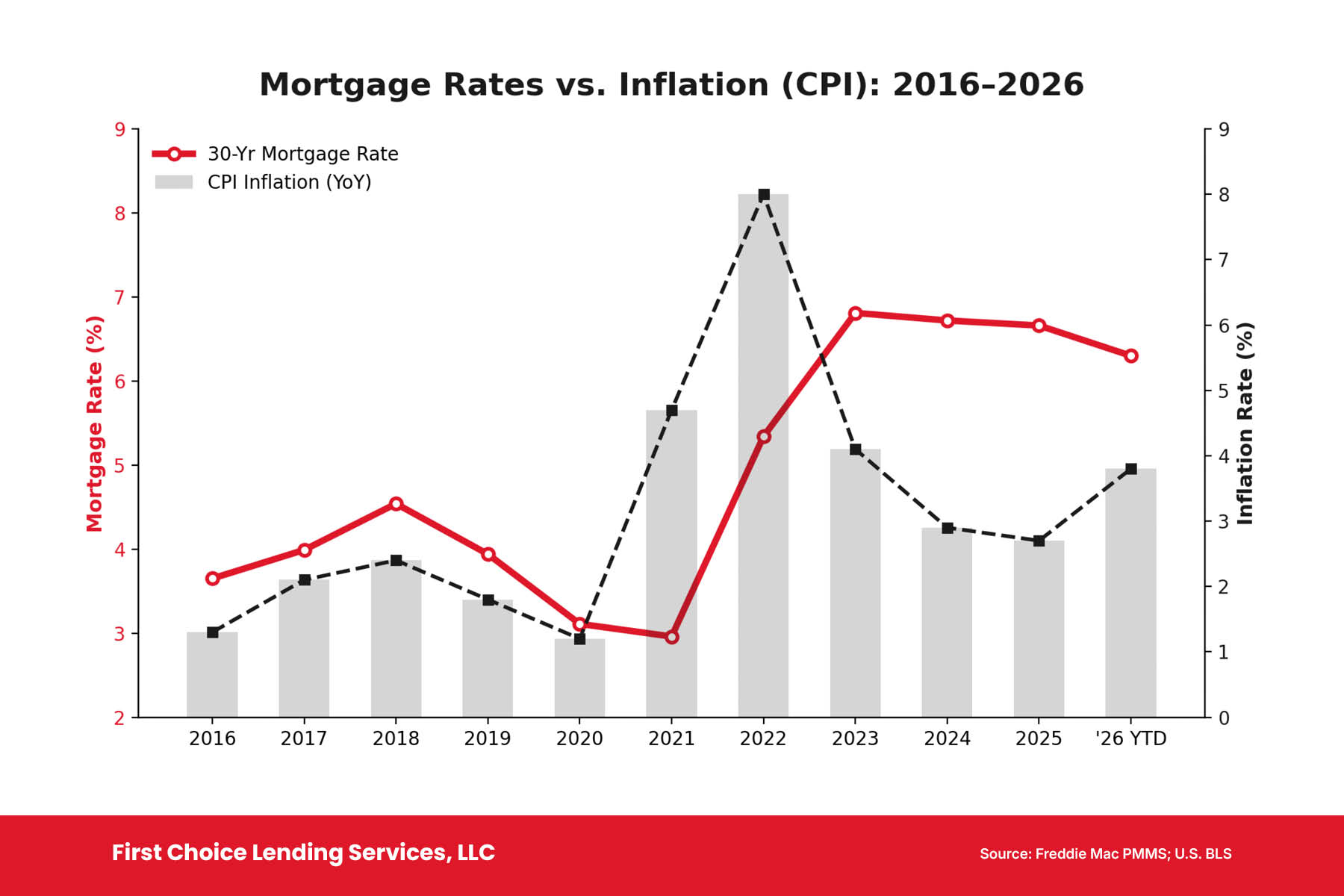
30-Year Mortgage Rate vs. CPI Inflation (YoY), 2016–2026 (Source: Freddie Mac PMMS; U.S. BLS)
Two reports receive particularly close attention each month:
- Consumer Price Index (CPI)
- Personal Consumption Expenditures (PCE)
Even small surprises in these reports can cause mortgage rates to move within hours as financial markets react.
Why it matters to homebuyers: Lower inflation generally creates a more favorable environment for mortgage rates, while stubborn inflation often keeps borrowing costs elevated.
3. Oil Prices & Global Events: The Wild Card
Oil prices and geopolitical events don’t directly set mortgage rates, but they can influence them surprisingly quickly.
When conflict develops in major oil-producing regions, investors immediately begin asking important questions:
- Will energy prices increase?
- Will shipping become more expensive?
- Will inflation rise?
- Will global markets become more volatile?
If oil prices climb significantly, transportation and manufacturing costs often increase as well. Businesses eventually pass many of those higher costs on to consumers, contributing to inflation.
At the same time, geopolitical uncertainty can create volatility throughout financial markets. Investors may move money into safer investments like U.S. Treasury bonds, which can sometimes help lower yields. In other situations, concerns about inflation from higher energy costs can push yields — and mortgage rates — higher.
Because several forces can be working at once, the market’s reaction isn’t always straightforward. That’s why mortgage professionals closely monitor both energy markets and major international developments. The relationship shows up clearly on a chart: oil and mortgage rates spiked together in 2022, but by 2023–2025, oil prices fell while mortgage rates stayed elevated near 6.7% — a reminder that oil is a contributing factor, not the direct driver:
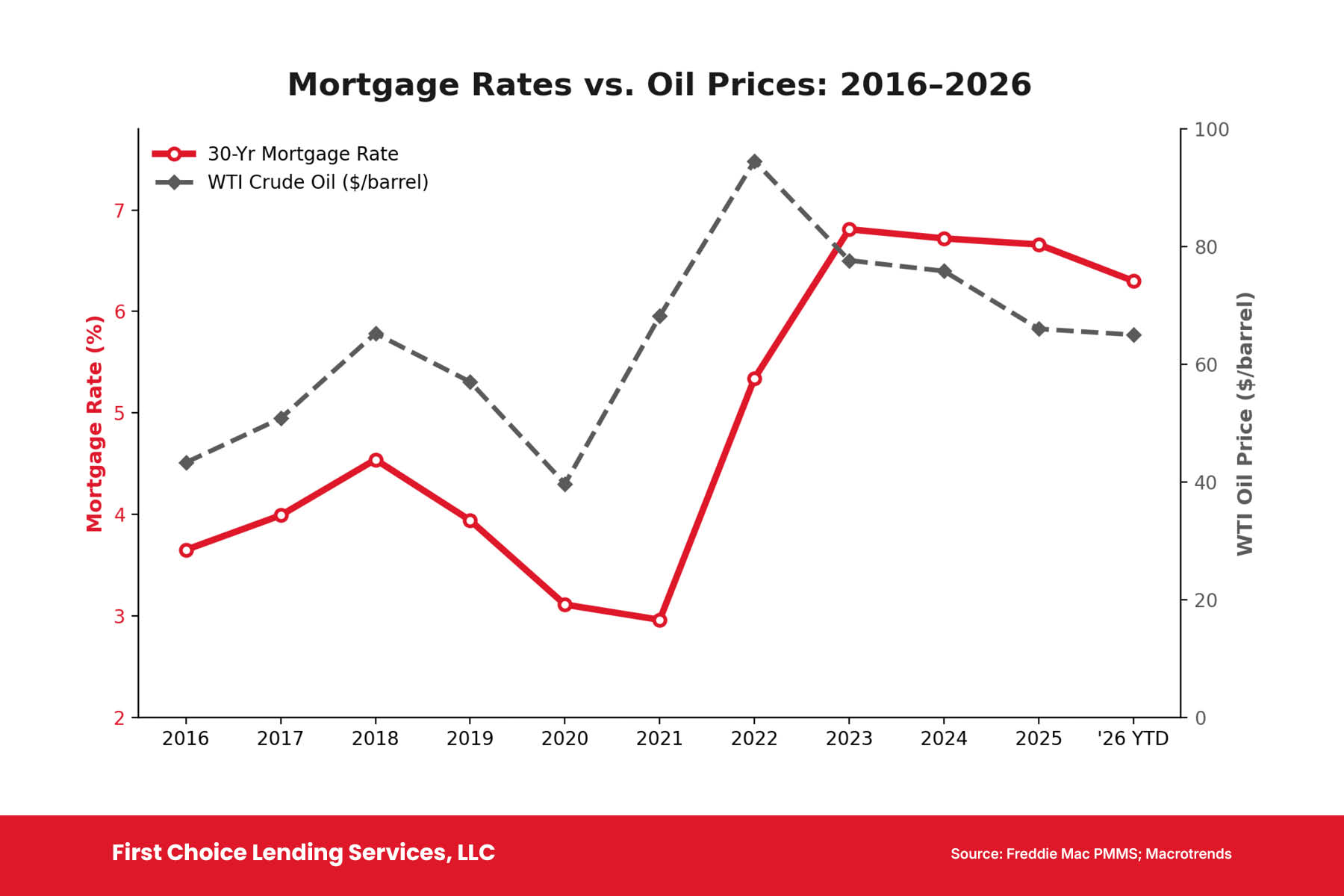
30-Year Mortgage Rate vs. WTI Crude Oil, 2016–2026 (Source: Freddie Mac PMMS; Macrotrends)
Why it matters to homebuyers: Events happening halfway around the world can influence mortgage rates here in the United States faster than many people realize.
Looking Beyond the Headlines
Every week brings new headlines about inflation, oil prices, employment reports, Federal Reserve meetings, and global events.
Some stories make for interesting news, but not every headline changes mortgage rates.
That’s why we spend time following the underlying economic indicators instead of reacting to every news cycle. Looking at the broader picture helps us better understand what may influence the market in the days and weeks ahead.
What Should Buyers Do?
One of the biggest mistakes prospective buyers make is waiting for the “perfect” interest rate.
The truth is, no one can consistently predict:
- Inflation reports
- Bond market reactions
- Global conflicts
- Oil prices
- Economic surprises
Rather than trying to perfectly time the market, focus on what you can control:
- Your credit score
- Your down payment
- Your monthly budget
- Getting pre-approved before you shop
- Buying when the payment fits comfortably within your financial goals
Remember, interest rates change. Home values change. Life changes. The right time to buy is when you’re financially prepared — not when you’re hoping to catch the absolute lowest rate.
The Bottom Line
Mortgage rates are influenced by many economic factors, but three indicators consistently help explain where the market may be headed:
- The 10-Year Treasury Yield — the strongest day-to-day indicator of mortgage rate movement.
- Inflation — the biggest long-term driver of borrowing costs.
- Oil Prices & Global Events — factors that can quickly influence inflation expectations and investor confidence.
While no one has a crystal ball, understanding these indicators provides valuable insight into why mortgage rates move the way they do. And when you understand what’s driving the market, you’re in a much better position to make confident, informed home financing decisions.
Have questions about today’s mortgage market or how current rates may impact your homebuying plans? Our licensed mortgage experts are here to help. Contact First Choice Lending Services at 855-392-4141 to discuss your options.