If you read our post on depreciation, you know the basic deal: the IRS lets you write off your rental building a little at a time, over 27.5 or 39 years. It’s a great benefit. It’s also slow.
A cost segregation study is how you speed it up, sometimes dramatically. For a furnished cabin in Gatlinburg or Pigeon Forge, it can move tens of thousands of dollars of deductions, sometimes more than $100,000, out of the next few decades and into year one.
Here’s how it works, when it’s worth it, and why it pairs so well with a DSCR loan.
What is a cost segregation study?
Quick answer: A cost segregation study is an engineering-based analysis that breaks a property’s cost into components, such as furniture, appliances, flooring, a hot tub, and site work, that can be depreciated over 5, 7, or 15 years instead of 27.5 or 39. With 100% bonus depreciation, many of those components can be deducted in the first year.
Without a study, your CPA generally treats the whole building as one big asset on one long schedule. The study’s job is to find everything inside that number that the tax code says wears out faster, and to document it well enough to hold up if the IRS ever asks.
What a study finds in a typical Smoky Mountain cabin
Turnkey short-term rentals are some of the most cost-seg-friendly properties out there because they’re packed with personal property. A qualified engineer decides what actually qualifies, but common examples include:
5- and 7-year property
- Furniture, beds, linens, and decor
- Appliances, washers, and dryers
- TVs, smart locks, and electronics
- Game room equipment: pool tables, arcade machines, foosball
- Hot tubs (depending on how they’re installed)
- Certain flooring, cabinetry, and decorative lighting
15-year land improvements
- Driveways, parking pads, and walkways
- Retaining walls, which mountain properties tend to have plenty of
- Landscaping, fencing, and outdoor lighting
- Fire pits, patios, and some exterior site work
A lot of what makes a cabin bookable (the hot tub with the view, the game room for rainy days, the paved drive that handles a winter morning) also happens to be what a cost segregation study pulls forward.
What it looks like in dollars: a Gatlinburg example
Say you buy a turnkey cabin for $650,000. The land is valued at $100,000, which leaves $550,000 of depreciable building. Your CPA uses a 39-year schedule because it’s a short-term rental.
| Depreciation | Without a study | With a study (25% reclassified) |
|---|---|---|
| Deducted in year one through bonus depreciation | $0 | about $137,500 |
| Regular depreciation on the rest | about $14,100 | about $10,600 |
| Total first-year depreciation | about $14,100 | about $148,000 |
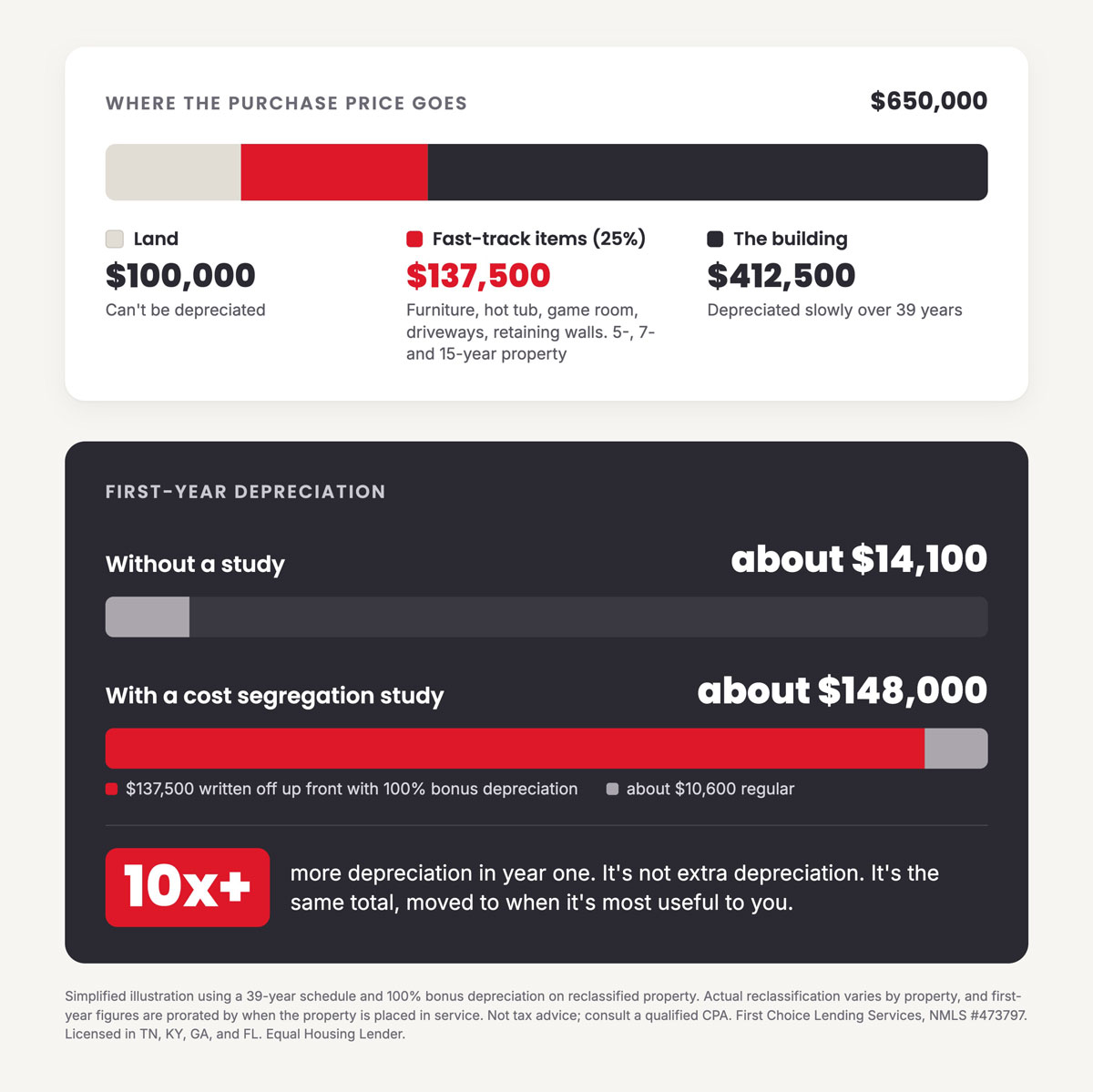
(Simplified for illustration. Actual reclassification percentages vary by property. Many furnished short-term rentals land somewhere around 20% to 30%. First-year figures are also prorated based on when the property is placed in service.)
That’s not extra depreciation. The total over the life of the property is the same. It’s the same deduction, moved to when it’s most useful to you.
Why it matters even more on a DSCR property
1. Big write-offs won’t hurt your next DSCR loan
A large paper loss looks great to your CPA and terrible to a conventional underwriter, who qualifies you on what your tax return shows. Plenty of investors have taken a huge cost seg deduction and then found they couldn’t qualify for the next property.
A DSCR loan qualifies you based on whether the property’s rental income covers its payment. Your tax strategy and your financing strategy stop working against each other, which is exactly what you want if you plan to own more than one cabin.
2. Turnkey cabins are built for it
Most Smokies cabins sell furnished and ready to book. That means a meaningful share of your purchase price is furniture, fixtures, and equipment, the stuff that depreciates fastest. A study simply documents what’s already there.
3. Tax savings and a cash-out refinance can fund the next cabin
If a study cuts your tax bill in year one, that’s cash you can put toward reserves, upgrades that boost your nightly rate, or a down payment on the next property. Down the road, a DSCR cash-out refinance can pull equity out of the property for the same purpose. Refinancing doesn’t change your depreciation, either, because your schedule is based on what you paid for the property, not on the new loan. That’s how a lot of investors go from one cabin to a small portfolio.
Is cost segregation worth it?
For many short-term rental owners, yes. But not for everyone. Run through these with your CPA:
- Can you use the losses? This is the big one. If your average guest stay is seven days or less and you materially participate, the losses may offset your W-2 or business income. That’s the short-term rental tax loophole, and it’s where cost segregation really shines. If you can’t meet those tests, the losses are generally passive. They carry forward, so they’re not wasted, but the immediate payoff is smaller.
- How big is the property? Studies cost money, often a few thousand dollars, with lower-cost options for smaller properties. The math usually works better as the purchase price climbs. Get a quote and compare it to the projected savings.
- How long will you hold it? Sell in a year or two and you’ll face depreciation recapture sooner. Faster-depreciated items like furniture are recaptured at ordinary income rates. Holding longer, or planning a 1031 exchange, helps.
- What’s your tax bracket? A deduction is worth more when your income is higher.
When to order a study
The cleanest approach is to talk with your CPA before closing, then order the study soon after the property is placed in service, so the results land on the same year’s tax return.
If you bought a few years ago and never did one, it’s usually not too late. A CPA can typically use a look-back study and an accounting method change (IRS Form 3115) to catch up the depreciation you missed in the current year, without amending old returns.
Quality matters
The IRS publishes an audit guide specifically for cost segregation, which tells you two things: it’s a recognized, legitimate strategy, and the IRS knows what a weak study looks like. Engineering-based studies with site visits or detailed photo documentation hold up better than a quick percentage plugged into software. Ask any provider how they build their numbers and what they’ll provide if the study is ever questioned.
Notes for experienced investors
- Partial dispositions: when you replace a component the study identified, like a hot tub, roof section, or appliance package, your CPA may be able to write off the remaining undepreciated value of the old one. A good study makes that much easier to document.
- Improvements after purchase: a game room build-out or deck expansion can often be segregated too.
- State returns: many states don’t follow federal bonus depreciation. If you live outside Tennessee, your state deduction could look very different.
- Material participation records: the cost seg deduction is only as strong as your hours log. Keep it contemporaneous, not reconstructed in April.
Your step-by-step game plan
- Talk to your CPA before you buy. Confirm the property can work as a short-term rental for tax purposes and that you can realistically meet material participation.
- Finance with a DSCR loan so your future write-offs don’t limit your future borrowing. Run the property through our free DSCR calculator first to see how it qualifies.
- Keep every closing document. Your Closing Disclosure and purchase contract feed directly into the study.
- Place the property in service. Furnished, listed, and ready for guests.
- Order the study and send the report to your CPA.
- Log your hours from day one.
Ready to buy your Smoky Mountain rental?
First Choice Lending Services finances short-term rentals across Sevier County and East Tennessee, from first cabins to growing portfolios. Our DSCR loans for Smoky Mountain short-term rentals are built around the property’s rental income, so your tax strategy and your next purchase can both move forward.
Not sure who to call for the study itself? We work with cost segregation specialists and CPAs who understand Smokies short-term rentals, and we’re happy to make an introduction. If you already have a cabin in mind, ask for a free rental history and investment analysis before you make an offer.
New to the tax side? Start with 12 Questions to Ask Your CPA Before Buying a Rental Property and Why Depreciation Is a Real Estate Investor’s Best Friend.
Frequently asked questions
Is cost segregation worth it for a single Airbnb? Often, yes, especially for a furnished short-term rental where the owner can use the losses through the seven-day average stay rule and material participation. Compare the study’s cost to the projected tax savings with your CPA.
How much does a cost segregation study cost? It varies by property size and the type of study. Many single-property studies run a few thousand dollars, and there are lower-cost options for smaller properties. Get a quote before you commit.
Can I do a cost segregation study years after buying? Usually, yes. A look-back study combined with IRS Form 3115 lets you catch up missed depreciation in the current year without amending prior returns.
Does a cost segregation study trigger an audit? Not by itself. It’s a recognized IRS strategy. What matters is a well-documented, engineering-based study and good records supporting your material participation.
Does cost segregation work with 100% bonus depreciation in 2026? Yes. 100% bonus depreciation is now permanent for qualifying property acquired after January 19, 2025, so components identified in a study can often be deducted in the first year.
Does a DSCR cash-out refinance affect my cost segregation study? No. Depreciation is based on what you paid for the property plus improvements, not on how it’s financed, so a refinance doesn’t reset or change your study.
This article is for educational purposes only and is not tax, legal, or financial advice. Tax rules change and depend on your situation, so talk with a qualified CPA or tax professional before making decisions. First Choice Lending Services, NMLS #473797. Licensed in TN, KY, GA, and FL. Equal Housing Lender. All loans subject to credit approval and underwriting guidelines.